
Key takeaways:
- Energy loss rarely comes from one obvious fault; it's spread across pipework, tanks, building envelopes, and equipment enclosures that nobody has assessed as one connected system
- The biggest wins come from whichever combination of surface area, temperature differential, and run time is largest, not from whichever fix looks most obvious
- Facility-wide savings show up gradually through shorter equipment cycles & flattening energy trends, not as a single dramatic drop on the next bill
Table of Contents
- Why energy loss is a design problem, not just a material problem
- Where insulation solutions deliver the biggest energy wins across a facility
- How to prioritise insulation upgrades across a site
- What an energy efficiency gain actually looks like on the ground
- Common reasons facilities underestimate their insulation losses
- How Total Insulation approaches facility-wide energy efficiency projects
- Explore this topic further
- Frequently asked questions
Why energy loss is a design problem, not just a material problem
Most facilities treat insulation as a material choice. Pick a product, install it, move on. But the energy a site loses through poor insulation is not really about the material on the shelf. It is about where heat flow escapes across the whole facility, and how many of those points get missed because nobody is looking at the site as one connected thermal system.
A pipe run can be correctly insulated while the vessel it feeds loses heat through an under-specified wall. A plant room can be well sealed while ductwork running through it bleeds conditioned air along its length. Heat transfer happens wherever there is a temperature differential and a weak point in the thermal insulation systems protecting it, and the biggest gains in industrial energy efficiency come from treating energy loss as a site-wide design problem, not a series of unrelated jobs.
This is also why the trigger for this kind of project rarely comes from one department. An energy audit might flag insulation as an opportunity, a sustainability target might need concrete action items, or a retrofit budget might simply need justifying to the people who approve it. Whatever the trigger, the facilities that get the most out of an insulation upgrade are the ones that start by mapping every point of loss across the site, rather than approving whichever fix happens to be raised first.
Where insulation solutions deliver the biggest energy wins across a facility
Some areas justify attention because the fix is simple and fast to pay back; others because the surface area is large enough that a small gain in thermal performance produces a significant saving. Four areas consistently account for most preventable energy loss in commercial and industrial buildings, and each responds to a slightly different combination of materials and installation approach.
Process pipework and ductwork
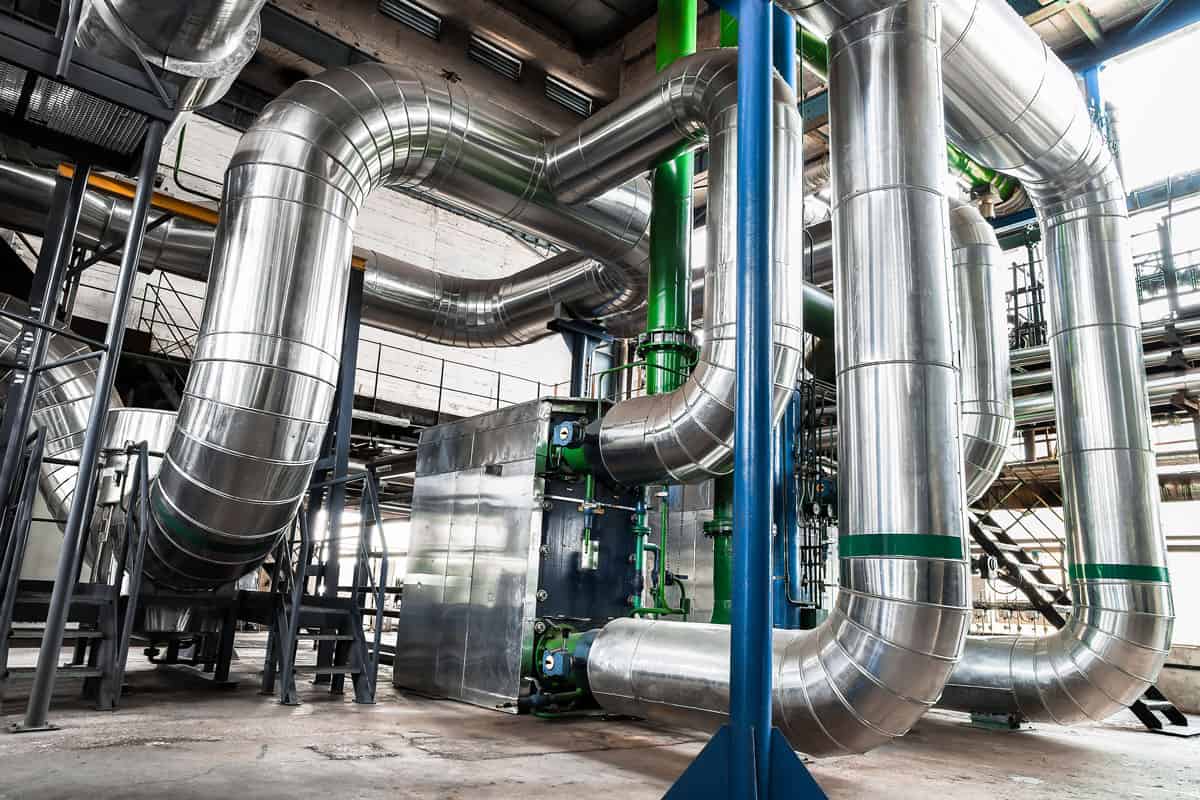
Pipework and ductwork insulation is usually the easiest energy loss to measure and the cheapest to correct, because the problem is localised and well understood. Correctly insulated pipe runs reduce the load on whatever system is heating or cooling that fluid or air flow, and because these losses are continuous, even a moderate improvement compounds over a year of operation. It is one reason high temperature pipe and duct insulation and low temperature pipe and equipment insulation remain among the most requested upgrades on industrial sites. Chilled and hot water pipework carries its own set of considerations again, since it needs to manage condensation and moisture control as much as heat loss itself, a topic our companion guide on how industrial pipe insulation improves operational efficiency covers in more depth.
Tanks, vessels, and cold storage
Large-surface-area assets like tanks, vessels, and cold storage structures lose energy in proportion to their size, so a small gain in thermal resistance on a big tank can represent a bigger saving than a dramatic improvement on a small pipe run. Many facilities judge cold storage purely on refrigeration efficiency, when the insulation layer around it is doing just as much, or as little, of the work. Bulk insulation and reflective foil insulation both have a role here, depending on whether the priority is resisting heat flow or reflecting radiant heat, and both help prevent condensation on chilled surfaces. Spray foam insulation is a common choice on irregular tank shapes where rigid boards are harder to fit, since it forms a continuous, gap-free layer around awkward geometry that a boarded system would need extensive cutting and sealing to match, an application our guide on where polyurethane foam insulation delivers the most value explores further.
Building envelope: roofs, walls, and plant rooms
Roof and wall insulation in commercial buildings gets less attention than process insulation, partly because it is specified once at construction and rarely revisited. Ceiling insulation, wall insulation, and floor insulation all affect how hard a plant room’s mechanical system has to work, and gaps in any of them, including around brick veneer walls and other external wall materials, sit quietly in the energy bill rather than showing up as an obvious fault. Poor moisture control and air leakage let water vapour absorb into building materials and degrade insulation performance over time, a different failure mode to the one industrial teams are used to troubleshooting in residential use. Retrofitting envelope insulation is also usually less disruptive than it sounds, since most of the work happens outside operating hours or around the outside of the building rather than inside the process areas it is protecting.
Equipment and machinery enclosures
Insulated enclosures around equipment that generates or needs to hold heat, such as ovens, dryers, hot flues, and processing machinery, reduce both energy loss and ambient heat gain in the work area. That has a knock-on effect on how hard nearby exhaust fans and cooling systems have to work, and it can meaningfully improve working conditions for staff positioned near hot equipment for long shifts. Thermal insulation covers are a common, cost-effective fix here, and where noise is also a concern, the material choice starts to overlap with acoustic insulation rather than thermal insulation alone, a distinction our guide on thermal versus acoustic insulation covers in detail.
How to prioritise insulation upgrades across a site
The biggest wins generally come from assets with the largest surface area, the greatest temperature differential from ambient, and the longest continuous run time, because those three factors multiply a small performance gap into a large energy cost. A short, poorly insulated pipe run operating an hour a day is a lower priority than a large tank holding a significant temperature differential around the clock, even if the pipe looks more obviously in need of attention.
Material selection matters too. Choosing insulation with low thermal conductivity and a high R-value suited to the process temperatures involved, rather than whatever is cheapest, is what separates a genuine energy-efficient upgrade from a cosmetic one, and a proper site assessment is the only reliable way to rank the list when the budget needs to maximise energy efficiency per dollar spent.
In practice, this usually means walking the site with a simple scoring approach rather than a full engineering study for every asset, by ranking each candidate on surface area, temperature differential, and run time, then starting with whichever combination scores highest across all three. It will not catch every edge case, but it gets a facility manager most of the way to a defensible priority list without commissioning a lengthy audit before any work can begin, and it gives project managers and engineers a clear basis to explain the sequencing to whoever is signing off the budget.
What an energy efficiency gain actually looks like on the ground
Energy savings from insulation upgrades rarely show up as one dramatic number on a bill. More often, they show up as reduced runtime on mechanical equipment, fewer temperature excursions that trigger a system to work harder, and a gradual flattening of an energy trend that had been creeping upward. Facilities that track this properly compare energy use against a baseline period, adjusted for production volume or ambient temperature, rather than expecting a before-and-after like a light switch. Lower energy bills follow steadily rather than immediately. The clearest confirmation is often qualitative before it is financial, as compressor cycles shorten, callouts for equipment running hot become fewer, or plant rooms simply feel less like a furnace in summer.
Common reasons facilities underestimate their insulation losses
Three patterns show up again and again. Insulation losses are distributed rather than concentrated. A facility might have 20 minor points of heat loss rather than one obvious failure, and each looks too small to justify attention, even though the total is significant.
Insulation also degrades gradually and invisibly. Compression, moisture ingress, and mechanical damage all reduce insulative properties well before any visible sign of failure, so a system can quietly underperform for years before anyone notices.
Teams often attribute energy loss to the equipment rather than the insulation around it. A refrigeration unit running longer hours looks like an equipment problem, when the cause is heat gain through poorly insulated walls and floors the unit is compensating for. This is also why insulation upgrades are sometimes deferred in favour of replacing the equipment itself, at a far higher cost and with a smaller efficiency gain than fixing the insulation around it would have delivered.
How Total Insulation approaches facility-wide energy efficiency projects
Since founding Total Insulation in 2002, director Tom Woollen has applied a principle he brought from more than 20 years in refrigeration plants and piping insulation beforehand, assessing facilities as one connected thermal system before recommending a single fix. Our team reviews process pipework, tanks, building envelope, and equipment enclosures together, working to Australian standards and manufacturer’s instructions as a baseline rather than a ceiling, and draws on an extensive range of insulation materials, from mineral wool and rock wool through to foam insulation and pre-insulated pipe, including non-combustible options wherever fire performance is a factor.
Long-term clients have described working with our team as consistently exceeding expectations, both professionally and on the ground, over several years. That kind of relationship is what a facility-wide energy efficiency project depends on, as both environmental and cost benefits compound the longer the insulation solution stays in place. If your facility is due for an assessment, our team can talk you through what is involved, across Queensland, Western Australia, and the wider Pacific Rim, and if you are still at the stage of appointing who will carry out the work, our guide on choosing an industrial insulation contractor sets out what project managers should look for before signing off.
Explore this topic further
This page covers the site-wide view. Each of the areas above is explored in more depth in its own guide:
- How industrial pipe insulation improves operational efficiency
- Where polyurethane foam insulation delivers the most value
- Thermal versus acoustic insulation: what is the difference?
- Choosing an industrial insulation contractor: what project managers should look for
Frequently asked questions
It varies with the condition of the existing insulation and the size and run time of the assets involved, but facilities with ageing insulation across pipework, vessels, and building envelope often find combined savings are higher than expected once every point of loss is accounted for.
It depends on which combination of surface area, temperature differential, and run time has the larger effect, not on which is easier to access. A proper assessment of the whole site, rather than one system in isolation, is the only reliable way to answer this for a specific facility.
Depending on the application, projects can involve mineral wool, rock wool, rigid boards, foam board, reflective foil insulation, and pre-insulated pipe, each chosen for the process temperatures, moisture exposure, and thermal resistance the specific part of the facility requires.
If insulation losses are showing up in more than one area, such as both process pipework and building envelope, a full assessment usually pays for itself by avoiding a series of one-off fixes that never quite add up to the saving a facility expected. A targeted fix is reasonable when the loss is genuinely isolated to a single, recently identified asset.
